Russia Conducts Nationwide Strikes on Ukraine, Killing Seven
- Russia conducted large-scale strikes against Ukraine, killing seven people across Donetsk, Kharkiv, Sumy, and Zaporizhzhia (Euronews).
Published by CFR's Wachenheim Center for Peace and Security
Updated October 21, 2026
Overview
Russia’s February 2022 full-scale invasion of Ukraine has caused more than one million casualties and left Russia occupying roughly 20 percent of Ukrainian territory. Ukraine has countered with long-range drone strikes that have knocked out up to 40 percent of Russia’s refining capacity, while Russia continues to bombard Ukrainian cities. U.S.-mediated talks between Russia and Ukraine have yet to produce a ceasefire, and the two sides remain divided over territorial concessions and security guarantees for Ukraine.
In late 2013, protests erupted in Kyiv after Ukrainian President Viktor Yanukovych rejected a deal for greater economic integration with the European Union (EU). State security forces violently cracked down on the demonstrations, causing protests to escalate. Yanukovych fled the country in February 2014, and a pro-Western interim government took power. The following month, citing the need to protect Russian citizens and Russian speakers in Crimea and southeast Ukraine, Russian special forces seized the peninsula. Russia formally annexed Crimea after a disputed local referendum in which Crimeans voted to join the Russian Federation.
The crisis heightened ethnic and regional divisions across Ukraine. In May 2014, pro-Russian separatists in Donetsk and Luhansk held independence referendums, and armed conflict quickly broke out between Russian-backed separatist forces and the Ukrainian military. Though Russia denied military involvement, both Ukraine and NATO reported Russian troops and equipment near Donetsk and Russian cross-border shelling. The conflict settled into an active stalemate, with regular shelling and skirmishes along the front lines.
In October 2021, U.S. intelligence detected a Russian troop build-up near Ukraine and shared its findings broadly with allies and the public. Satellite imagery and social media posts confirmed the movement of armor, missiles, and other heavy weaponry toward the border. In mid-December 2021, Russia demanded that the United States and NATO cease military activity in Eastern Europe, commit to no further NATO expansion, and prevent Ukraine from joining NATO. The United States and NATO rejected these demands and threatened severe economic sanctions on Russia.
By early February 2022, Russia had deployed its largest force to the Belarus border since the end of the Cold War. Negotiations failed to bring about a resolution. In late February, Putin ordered troops to Luhansk and Donetsk for a “peacekeeping function,” prompting U.S. sanctions on the regions and the Nord Stream 2 gas pipeline. Ukrainian officials downplayed the threat of an invasion and delayed military mobilization.
On February 24, 2022, Putin announced a full-scale land, sea, and air invasion, targeting military assets and cities across the country. Putin claimed the operation aimed to demilitarize and denazify Ukraine and end the alleged genocide of Russians in Ukrainian territory. On March 2, 141 of 193 UN member states condemned Russia’s invasion and demanded immediate withdrawal.
Ukraine’s military mounted a stronger-than-expected resistance, repelling Russian forces from Kyiv and frustrating Moscow’s apparent assumption of a rapid, decisive victory. Aided by Western intelligence sharing and an influx of anti-tank and air defense weapons, Ukrainian forces held the capital and pushed back Russian advances.
Later that month, Russia announced a “reduction in military activity” near Kyiv and Chernihiv, followed by a full withdrawal of all troops from Ukraine’s capital region. In Kyiv’s surrounding areas, Russian forces were found to have committed apparent war crimes, including summary executions, torture, and rape. The scale of civilian casualties prompted calls for war crimes investigations and referrals to the International Criminal Court.
A few weeks later, Russia launched a new major offensive in eastern Ukraine. By May, Russian forces had taken control of Mariupol, a strategically important port city in southeastern Ukraine, while ongoing fighting near the Zaporizhzhia nuclear plant repeatedly raised fears of a nuclear disaster.
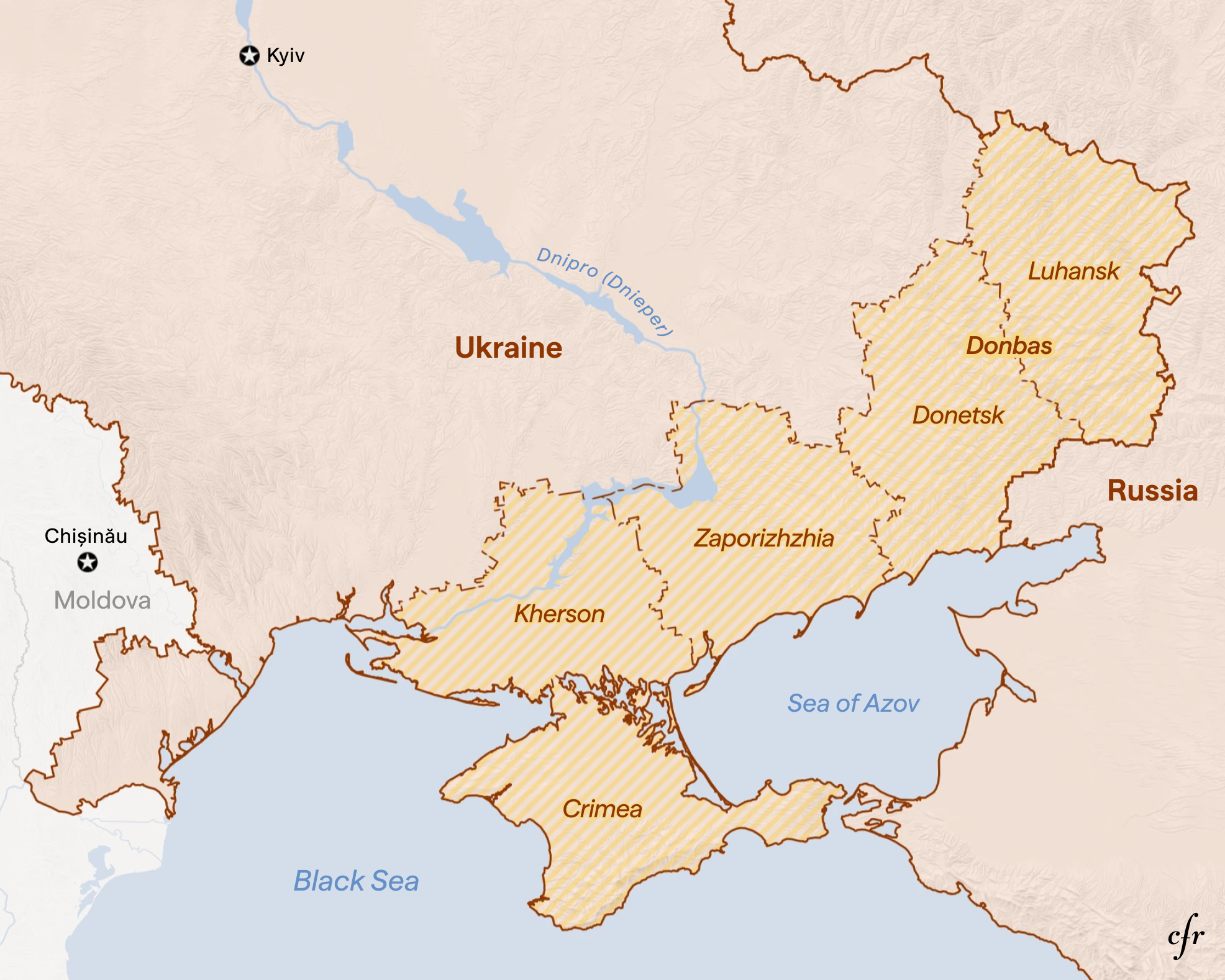
In September 2022, Ukrainian forces launched a sweeping counteroffensive in the northeast and south, recapturing more territory in the Kharkiv region in days than Russia had seized in months, cutting off important supply lines at Lyman. By November, Ukrainian forces had retaken Kherson—the only regional capital Russia had captured since the full-scale invasion—forcing a Russian withdrawal from all territory west of the Dnipro River.
Meanwhile, Putin moved to illegally annex four occupied territories: Luhansk, Donetsk, Kherson, and Zaporizhzhia. In his accompanying speech, Putin warned that Russia would defend the annexed territories with “all the means at our disposal,” issuing veiled nuclear threats. In early 2023, Russian forces captured the nearby town of Soledar before launching an offensive that devolved into a months-long siege of Bakhmut, a town that assumed an outsized significance for both sides. The United States estimates that Russia suffered one hundred thousand casualties in the battle. By late May, Russia claimed control of the city.
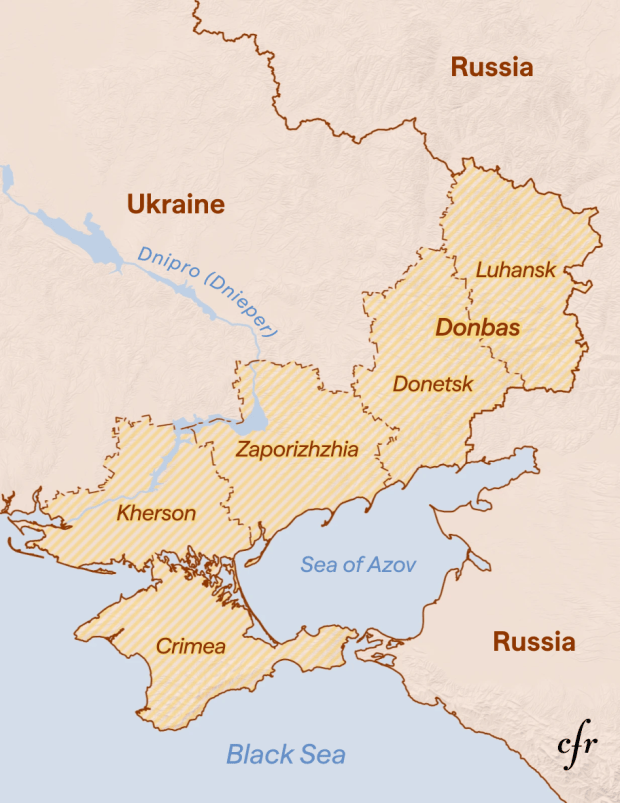
In June 2023, Ukraine launched a much-anticipated counteroffensive, attempting to break through Russian defenses eastward in Donetsk province and southward in Zaporizhzhia province, the land corridor to Crimea. Ukrainian forces met stiff resistance and suffered heavy losses against hardened Russian defensive positions, air superiority, and minefields. Nonetheless, Ukraine stepped up long-range strikes on Crimean infrastructure and Russian naval assets. Kyiv also began attacking targets inside Russia itself, signaling a willingness to expand the conflict beyond its borders.
In November 2023, Commander-in-Chief Valerii Zaluzhnyi said the war had reached a stalemate after Ukraine’s failed counteroffensive. His assessment put him at odds with Zelenskyy, who remained publicly committed to retaking lost territory. In February 2024, Zelenskyy replaced him with General Oleksandr Syrsky. Soon after his appointment, Syrsky ordered the withdrawal of troops from Avdiivka, a strategically important town in Donetsk, where fighting was ongoing for four months. He argued the retreat was necessary to avoid being encircled. The decision, however, handed Russia its most significant battlefield victory since the capture of Bakhmut.
Since 2023, Russia has continued its attritional advances across much of the 750-mile front without achieving a significant breakthrough. In August 2024, an estimated eleven thousand Ukrainian troops advanced into Kursk Oblast in the largest foreign attack on Russia since World War II. The surprise attack complicated Russia’s fall 2024 offensive efforts, as Moscow’s military command gathered around seventy-eight thousand troops to expel Ukrainian forces.
Moscow effectively controls all of Luhansk province, while Ukraine holds roughly 19 percent of Donetsk province. In February 2026, Ukrainian forces mounted a counterattack in Zaporizhzhia province, one of the most fluid parts of a largely frozen frontline. They regained an estimated 100 square miles of territory, the first month since 2023 in which Ukraine gained more than it had lost. In response, Russian forces have intensified their assaults, particularly against the town of Huliaipole, in Zaporizhzhia province, and the cities of Pokrovsk and Myrnohrad in Donetsk province. Moscow’s forces have also concentrated fighting around the logistical hub of Kostiantynivka, which they entered in December 2025. Russia aims to seize Kramatorsk and Sloviansk, the last major cities under Ukrainian control in Donetsk province.
Russia has received major military support from North Korea, which has sent between fourteen thousand and fifteen thousand soldiers to fight alongside Russian troops. Pyongyang has also reportedly provided weapons, including ballistic missiles, long-range artillery, and multiple launch rocket systems. In July 2025, South Korea’s Defense Intelligence Agency reported that North Korea had sent more than twelve million artillery shells in total, roughly half of all Russian artillery shells, according to Ukraine’s military intelligence agency.
Ukraine, for its part, has made significant technological advancements to sustain its fight against a larger Russian force. In June 2025, Ukraine launched 117 attack drones to target airfields deep inside Russian territory, in what Ukrainian officials named “Operation Spider’s Web.” Ukrainian drones and missiles have also targeted the Black and Azov seas; according to Ukraine’s Defense Ministry, roughly 30 percent of Russia’s Black Sea Fleet had been destroyed or seriously damaged by early 2026. Since the spring of 2026, Kyiv has used an upgraded long-range arsenal that contains many drone models, along with a growing quantity of domestically developed cruise missiles. Ukraine has also developed unmanned ground vehicles equipped with machine guns that use artificial intelligence to quickly identify drones.
Ukraine has increasingly struck Russian oil facilities, aiming to deprive Moscow of a considerable source of funding for its war effort. Throughout the spring of 2026, Ukraine launched a series of drone strikes against port terminals. Four separate attacks on the oil facility at the Black Sea port of Tuapse disrupted Russian exports. Ukraine has also hit oil refineries, leading to reports of capacity reductions.
Russia, in turn, has targeted Ukraine’s energy system, with attacks intensifying since the spring of 2024. One of the largest, in August 2024, cut power to eight million households. Between December 2025 and February 2026, Ukraine endured fifteen large-scale attacks on its energy facilities involving swarms of drones and missiles. Ukraine’s energy grid has come close to collapse on several occasions; in January 2026, Kyiv residents spent an average of half of every day without power.
Since assuming office in January 2025, President Donald Trump has repeatedly made attempts to broker a peace deal between Russia and Ukraine. In March 2025, Trump directed a “pause” to U.S. assistance to Ukraine, as he sought to pressure Zelenskyy to engage in negotiations to end the war with Russia. In May 2025, direct peace talks between Ukrainian and Russian negotiators took place for the first time since early 2022, producing the largest prisoner swap of the conflict. The two delegations reconvened for a second round, which ended swiftly without a breakthrough. In August 2025, Trump and Putin met in Alaska to discuss ending the war in Ukraine, though no agreement was announced.
In November 2025, Trump presented a twenty-eight-point draft proposal to end the war in Ukraine, developed by Washington and Moscow. The proposal called for Ukraine to cede territory and barred the country from joining NATO. It also lifted sanctions on Russia and returned Moscow to the Group of Seven (G7), formerly the Group of Eight (G8), which includes many of the world’s biggest economies. After rejecting the proposal, Ukraine worked with the United States to create a revised twenty-point peace plan. In December 2025, Zelenskyy met with Trump to discuss the plan. Afterward, Trump said he believed that Russia and Ukraine were “maybe very close” to a deal. Putin’s aides, however, were dismissive of several proposals, including the deployment of European peacekeepers to Ukraine.
In February 2026, the United States set a June deadline for Ukraine and Russia to reach a deal. In May 2026, Trump requested a three-day ceasefire and an exchange of prisoners, which Zelenskyy and Putin agreed to. The ceasefire, however, quickly unraveled, with both sides blaming the other for their continued fighting.
For CFR’s full coverage of Ukraine, please visit our Securing Ukraine’s Future Initiative.
Key Actors
A country defending its sovereignty against Russia’s invasion, which has left roughly 20 percent of its territory under Russian occupation, while increasingly countering with long-range strikes on oil, energy, and military targets inside Russia
The main aggressor that launched a full-scale invasion of Ukraine in 2022, and has since declared the illegal annexation of four Ukrainian oblasts (Donetsk, Luhansk, Zaporizhzhia, and Kherson) and sought to consolidate military control over them
Previously the largest single-country provider of military assistance to Ukraine, under President Donald Trump the country is now primarily a diplomatic mediator and seeks to use its leverage over both parties in ceasefire negotiations
A staunch supporter of Ukraine that has ratcheted up economic pressure on Russia through sanctions and now provides more total assistance than any other backer
The military alliance whose member states have collectively coordinated weapons transfers to and training and intelligence support for Ukraine and maintained forward deployments on its eastern flank, as Russian drone incursions test the coalition’s response
Russia’s closest ally, which was used as a staging ground for the initial invasion and has since conducted joint nuclear exercises, permitted overflight for drone attacks, and become integral to Russia’s defense manufacturing industry
A Russian ally that pledged “unconditional support” in the form of artillery ammunition and ballistic missiles and deployed roughly fourteen thousand to fifteen thousand soldiers to support Russian operations
A military and diplomatic partner that seeded Russia’s Shahed drone program through early drone transfers and technology-sharing, and reportedly receives reciprocal support from Russia in its war with the United States and U.S. Middle Eastern partners
An essential economic and strategic partner to Russia, providing dual-use items for Russian defense manufacturing
Recommended Resources